
Debating the Impact of AI Adoption in Agribusiness with Virtual experts
“Agentic AI” refers to AI systems that are designed to act autonomously: the system makes decisions and takes actions to achieve specific goals with minimal human oversight. It is where AI makes the jump from being a tool that responds to prompts to being a system that can understand context, can reason, can adapt plans, and can even act independently.
In March 2025, AgriTech Capital and LSC International decided to test just how well Agentic AI understands the Agribusiness world. Using Chat GPT, we created a panel of six virtual participants (i.e. the participants are AI Agents, not human experts).
The six virtual (Agentic) experts are:
a large-scale farmer
a seed company executive
an AgTech startup CEO
a fertilizer company executive
agricultural cooperative executive, and
a major grain trading company executive.
We then created a moderated discussion among the ‘experts’, asking them to discuss how artificial intelligence (AI) is shaping the food and agribusiness sector, using the same six key questions that we had previously posed to 40 human experts in AI and Food / Agri experts (the findings of which were published in two previous blogs). The result was a 6000-word report summarizing the insights from the virtual experts as to how AI will be used in the global food supply chain.
Some observations:
In comparing the human food / agri experts and Agentic-AI responses we found that the human responses were not as deep or comprehensive as those of the virtual agentic panel. The tables below demonstrate where the biggest opportunities lie for Agentic AI to supplement human responses.
In fairness to our human experts, they were asked to give their ‘top-of mind’ responses, whereas the ChatGPT responses could be considered to have ‘had more time to think’. It’s important to point out that computer agents will communicate thousands of times faster than their human counterparts, since they are using computer language, which eliminates risks of misunderstandings (but also can miss nuance).
To our knowledge, this is the first example of such a technique being used in the agriculture or food production industries, but it affirms our expectation that the use of Agentic AI (virtual AI experts) will increase rapidly and result in greater changes that currently imagined. Is the food industry or agriculture ready?
In June, 2025 we repeated this exercise, this time with a larger and more specifically defined group of experts, resulting in a 35,000-word report, but there was clear evidence that ChatGPT was already using our two LinkedIn blogs as source material, in place of the references below, biasing the process. Hence our decision to report only the first version of the debate. The fact that many of the references from consulting groups etc. were replaced by our own Forbes article and LinkedIn blogs demonstrate the speed with which new material is ‘scraped’ or collected across the digital universe for the appropriate content.
The headline finding: we have already moved from Co‑Existence to Co‑Creation
From our perspective the debate has already shifted from “Will AI replace agri-food experts?” to “How fast can we pair algorithms with agri-food experts to unlock new value?” Our synthesis of 25 expert interviews and a six‑member operator panel (20th Mar 2025) shows that productivity breakthroughs emerge when people and machines are deliberately co‑designed to learn from one another.
Three collaboration principles stand out:
AI amplifies, not substitutes. Experts’ experience, understanding and intuition guides data curation: AI then scales that judgement across millions of acres.
Feedback loops trump one‑off pilots. Continuous farmer feedback retrains models monthly, pushing accuracy well above static tools.
Governance creates trust. Clear “explainability checkpoints” reassure users and regulators, accelerating adoption.
The tables offer collaboration‑focused diagnostics and other tools (including an action roadmap) for organizations looking to jump-start integrating AI into their business processes;
Literacy Assessment, a look at the relative understanding of AI and Generative AI (GenAI)
Five Criteria for Collaboration Readiness
Collaborative Insight Themes
Integrated 6‑ & 12‑Month Action Plan
Collaboration Blueprint—Three Practical Plays
1. Literacy Assessment—Who really understands AI & Generative AI (GenAI): Humans of Agentic AI?
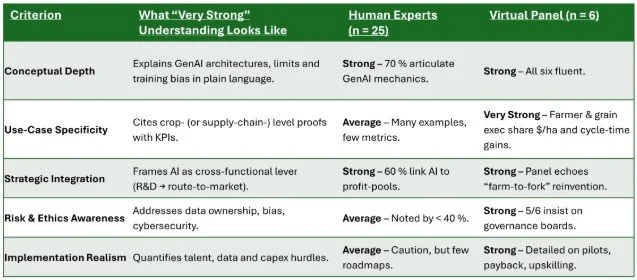
"AI is only as good as the data it learns from.” — Virtual panel, Seed‑company executive
“We risk over‑automating and under‑thinking local context.” — Sylvain Charlebois
2. Five Criteria for Collaboration Readiness
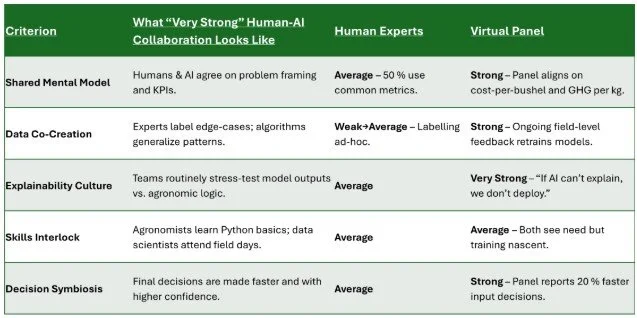
“The most effective diagnosis came from the doctor plus AI—neither alone could match the accuracy.” — Wolfram Schlenker
“AI multiplies expertise, it doesn’t replace it.” — Virtual panel, AgTech‑startup CEO
3. Collaborative Insight Themes
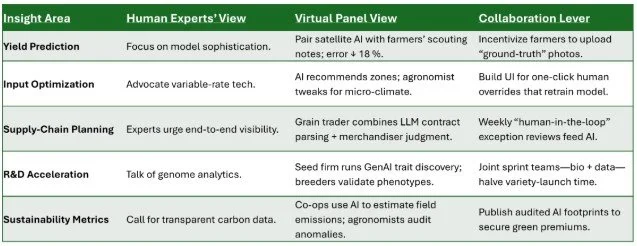
“If it doesn’t work on the farm, it doesn’t matter.” —Virtual Panel, AgTech‑startup CEO
“AI will cut through complexity, if humans keep it honest.” — AJ Shelman
4. Integrated 6‑ & 12‑Month Action Plan
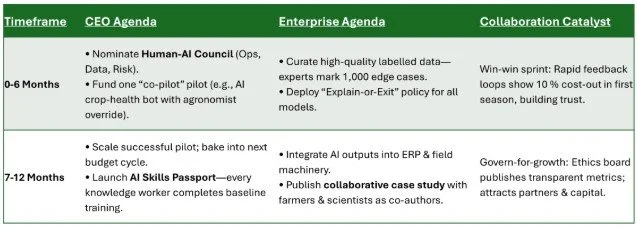
“Pick real problems that need both agronomy and algorithms.” — Rob Dongoski
5. Collaboration Blueprint—Three Practical Plays
Closed‑Loop Learning Pods Form pods of one data scientist + one agronomist + one grower to refine a specific model weekly. McKinsey benchmarks show pods lift model accuracy 30‑40 % vs. siloed teams.
Explainability Dashboards at the Edge Deliver field‑level AI recommendations with a “Why‑Meter” that surfaces top three data signals. Operators report a 2× jump in adoption when they understand the ‘why’.
Farmer Data Dividend Share 5‑10 % of algorithm‑driven savings (e.g., fertilizer reduction) back to data‑contributing growers. Early pilots doubled participation rates in under six months.
Bottom Line
The fastest‑moving Agri‑Food players treat people and algorithms as complementary assets—humans frame questions, AI scales answers, and each iteration tightens the loop. Embedded collaboration by design and the sector can deliver higher yields, lower inputs, and credible sustainability gains—together.
The goal as we see it is not to replace humans in the businesses of food and farming with AI, but humans who find the way to harness the power of AI will replace humans that don’t.
